
General concepts
On HEC markets, rewards are deducted from borrowers’ collaterals as a form of payment, whileUSG is above a predefined price threshold. If USG falls below the price threshold, 100% of collaterals’ rewards are cut, and an interest rate is applied.
The rewards deduction follows a step function, which is ruled by the following parameters:
steps⇒ the number of distinct rewards cut steps;R_min⇒ the minimum rewards deduction rate;R_max⇒ the maximum rewards deduction rate;P_max⇒ the price ofUSGat which the minimum rewards deduction rate (R_min) is applied;P_min⇒ the price ofUSGat which the maximum rewards deduction rate (R_max) is applied.
USG’s price is above P_max, the rewards deduction rate is always equal to R_min and, if USG’s price is below P_min, the rewards deduction rate is always equal to R_max.
The price delta (ΔP) between each step is always constant, and is equal to:
Similarly, the rewards deduction delta (ΔRd) between each step is always constant, and is equal to:
Examples
Below are two examples showing how the rewards deduction rate behave depending on its parameters.Example 1
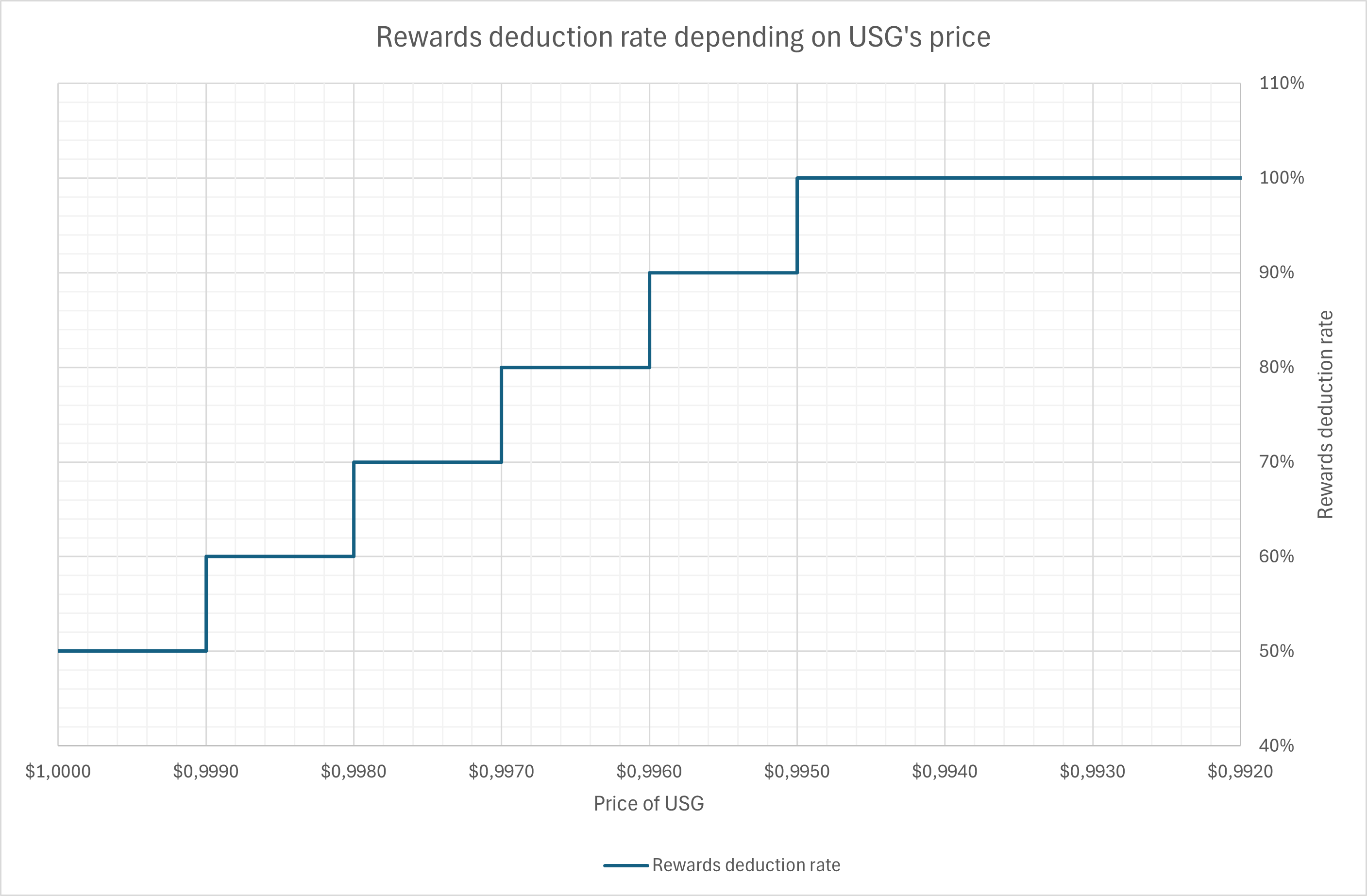
If we consider the following parameters:steps= 6R_min= 50%R_max= 100%P_max= $1P_min= $0.995
Example 2
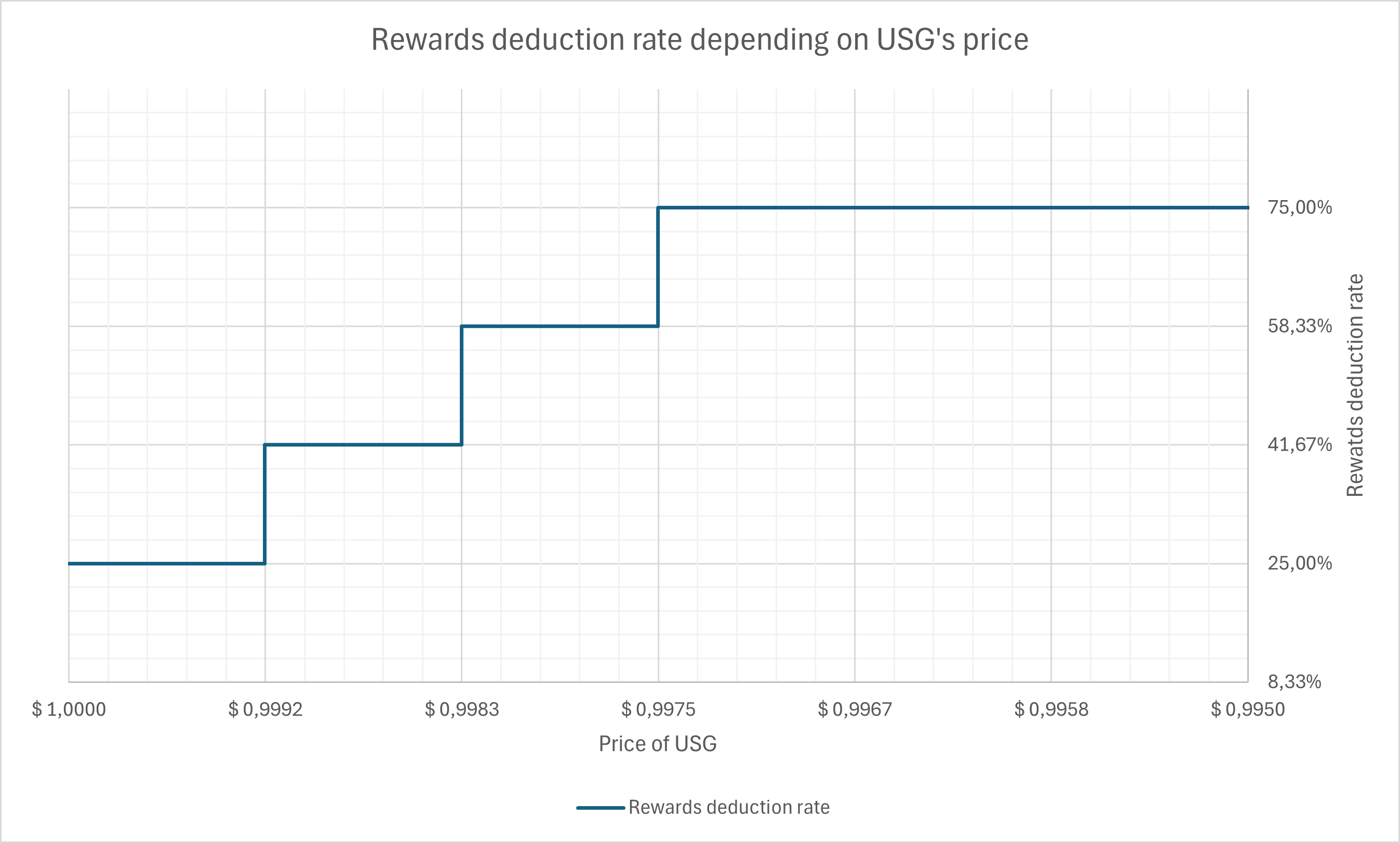
If we consider the following parameters:steps= 4R_min= 25%R_max= 75%P_max= $1P_min= $0.9975